Structure Holds Vision: The Leadership System CEOs Need
When people talk about leadership, they almost always focus on the leader.
Leadership style.
Communication skills.
Decision-making ability.
But a leader’s style is only half the picture.
The success of an organization rarely comes down to CEO personality or leadership style. What really determines whether a vision becomes reality is something far more practical:
The leadership structure of the organization.
Structure determines how decisions are made, how responsibility is distributed, and whether the CEO becomes the bottleneck.
And if you’re a CEO with a big vision, good leadership structure is what enables you to delegate outcomes to a team of leaders and frees you up to provide leadership around vision and direction.
Because the bigger the vision becomes, the more pressure it places on both the organization and the leader.
Structure is what allows the organization to hold that vision so the CEO doesn’t have to carry it alone.
Vision Starts with One Person
Most organizations begin with one person seeing something others don’t see yet.
A possibility.
A solution.
A better future.
That vision often belongs to the founder or CEO.
In the early stages, the CEO does almost everything required to move that vision forward from something in their mind to something tangible in real life. Strategy, fundraising, programs, hiring, partnerships, operations. It’s all closely tied to one person’s energy and direction.
And for a while, that works.
But the moment the making that vision a reality grows beyond what one person can personally execute, the job of the CEO changes.
It is no longer just about working harder or doing more.
The real job becomes building an organization capable of carrying the vision forward… And letting go of trying to carry it themselves.
And that requires structure.
Without it, everything requires energy from the CEO.
Every decision.
Every problem.
Every opportunity.
The work of the CEO feels like pushing a boulder up a hill. Forward movement is dependent on the CEO and stuck behind an ever growing boulder, the CEO loses sight of the future, and eventually forward movement grinds to a frustrating crawl.
If this feels like you, keep reading… because there is a way to get that boulder rolling downhill without you and freeing you up to determine where you want that boulder to go!
When Vision Outruns Structure
One of the most common patterns I see with CEOs is that their vision grows faster than the structure of the organization.
This is natural. Visionary leaders are often able to see possibilities far ahead of the current capacity of the organization.
But when the structure doesn’t evolve along with the vision, the result can feel chaotic.
Priorities change frequently.
Teams struggle to keep up.
People feel uncertain about direction.
Sometimes I jokingly refer to this as visionary CEO whiplash.
The CEO isn’t wrong. The ideas may all be good ones.
But without a structure that stabilizes execution, the organization can’t absorb that level of change.
The right structure provides the opportunity for vision to expand without overwhelming the people responsible for execution.
And this requires two things to happen:
1) The CEO or visionary needs to be freed up from other management and leadership decisions so they can run ahead into the future and explore opportunities and ideas.
2) We need a system that doesn't drag the entire team along the journey that the visionary will take, running into the future.
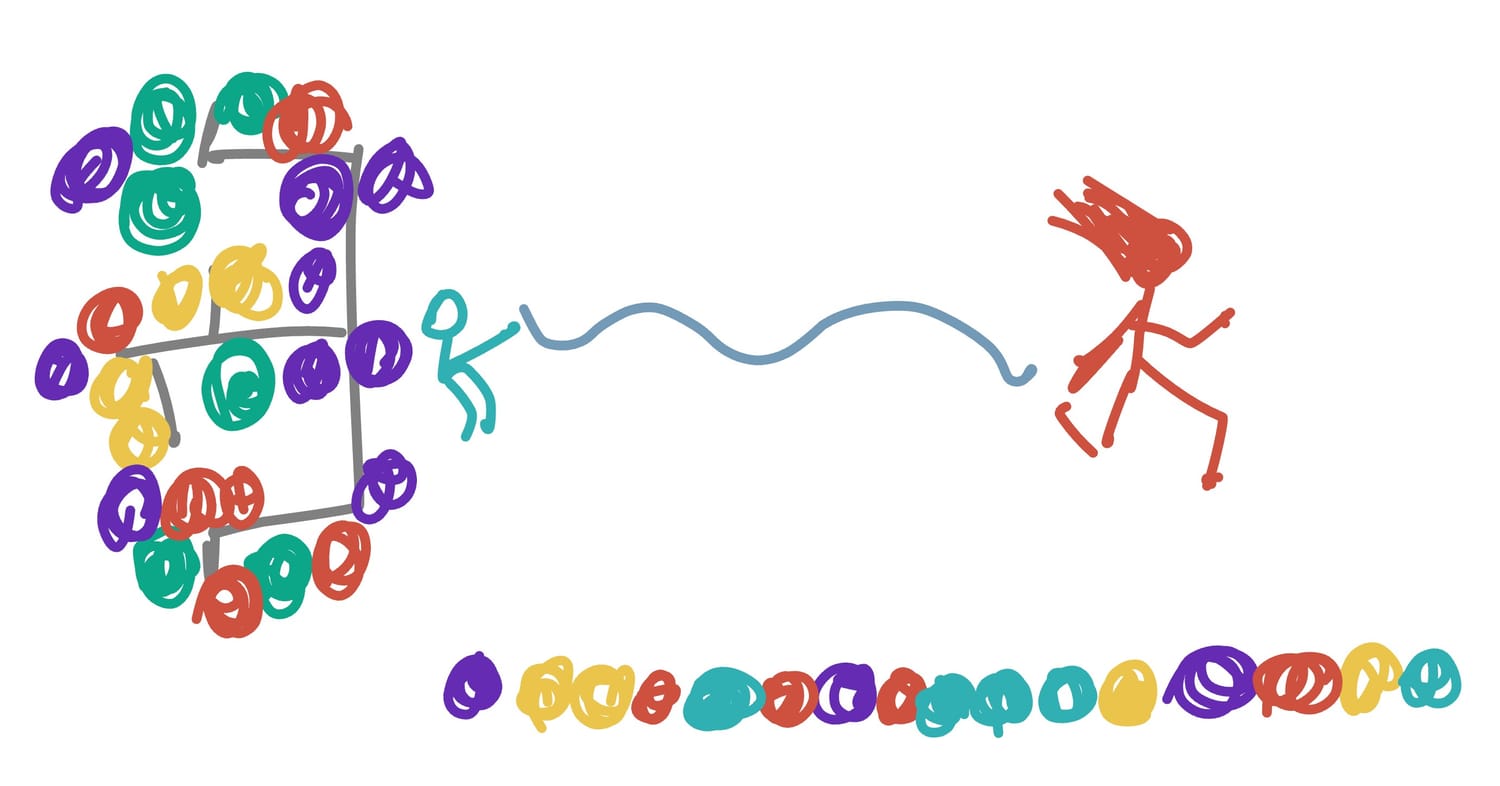
Visually, I like to imagine this as a long tether that attaches the visionary CEO to the rest of the organization. It provides plenty of slack while they run ahead into the future, so that it doesn't tug on the rest of the organization, but they are still connected with the through line of direction.
The Other Side of the Problem
Of course, too much structure creates its own issues.
Most CEOs have experienced organizations where the structure becomes rigid.
Endless approvals.
Layers of bureaucracy.
Decisions that take months instead of days.
If your structure is causing you to slow down and experience less joy, then you probably have a bad structure or bad systems and processes in place.
The goal is the right structure.
Great leadership structure distributes responsibility and makes teams feel supported rather than constrained.
The best leadership structures unite our teams and ignite momentum.
Leadership Structures We Inherit (but perhaps should let go of)
Most organizations don’t design their leadership systems intentionally.
They simply inherit the structures they are familiar with.
The most common example is a hierarchy of people in charge of people.
If your organization has an org chart, or a system of supervisors who people report to… you have a hierarchical leadership system.
People are arranged in layers, and authority flows from the top downward. One person supervises another, who supervises another.
This model concentrates decision-making power in a small number of roles.
If the goal is to consolidate power and centralize control, hierarchy works well.
But many organizations today are trying to achieve something different. They have goals related to impact.
They are trying to execute a mission that requires collaboration, creativity, and rapid decision-making.
Their goal is not to give the CEO maximum power.
In those environments, traditional hierarchy often creates decision bottlenecks and limits growth and momentum.
Organizing Leadership Around Outcomes
A more effective leadership structure organizes the organization around outcomes instead of supervision.
Rather than asking who reports to whom, the organization asks a different question:
Who owns which outcomes?
Each critical outcome in the organization has a clear owner responsible for achieving it.
These are the primary outcomes that I use with my clients implementing the Impact Method®:
Clear direction and vision
Optimized capacity and pace
Maximized/leveraged resources
Maximum usable funding/revenue
Program or product impact
Instead of decisions flowing upward through a hierarchy of people, they are distributed across leaders responsible for these outcomes.
The new hierarchy becomes one of decisions that impact other outcomes. For example, a change in overall direction affects all the other outcome categories, whereas a change in program or product impact typically does not change the other outcome categories as much.
Why This Matters for the CEO
When an organization lacks outcome ownership, the CEO becomes the central nervous system of the entire organization.
Information flows through them.
Decisions require them.
Problems return to them.
It is exhausting! And not just for the CEO… it’s actually exhausting for the entire team!
And more importantly, it limits how far the organization can grow.
A CEO can only personally manage so many decisions.
But when leadership is distributed through outcome ownership, something changes.
The organization becomes more resilient.
Leaders develop real ownership.
Decisions move faster.
Teams grow stronger.
And the CEO gains the space needed to focus on what only a CEO can do: guiding the future.
Structure Supports the CEO’s Capacity
There’s another reason this matters that CEOs don’t talk about enough.
Vision creates pressure.
Holding a big vision requires emotional and cognitive capacity. The CEO is often responsible for making difficult decisions, navigating uncertainty, and maintaining confidence even when the path forward isn’t obvious.
When the organization lacks structure, that pressure increases dramatically.
The CEO carries the strategic direction, the operational decisions, and the emotional weight of the organization.
Over time, that becomes unsustainable.
But when the structure distributes responsibility clearly, the CEO no longer carries the entire system alone.
The organization itself begins to hold the vision.
That frees the CEO to lead rather than constantly manage.
A Simple Starting Point
Shifting leadership structure doesn’t require reorganizing everything overnight.
A simple place to begin is identifying the organization’s key outcomes (yes, you can use the list above) and asking a few questions:
Who currently owns this outcome?
Is ownership clearly a single person, shared, or not really owned by anyone?
If it’s shared, make a plan for one person to own it. If it isn’t owned by anyone, make a plan for it to be owned in the future.
In many organizations, the CEO’s name appears in nearly every box.
That’s a sign that leadership responsibilities need to be distributed.
Over time, outcome ownership can be owned to capable leaders across the organization.
Each outcome has a clear owner.
Some leaders may own multiple outcomes. Others may grow into new ones over time.
The result is a leadership system that distributes responsibility while maintaining alignment around the mission.
Check out this episode of my podcast for more on how to delegate outcomes Inspired Nonprofit Leadership Episode #389: Outcome Ownership Can’t Be Assigned
Mentorship Instead of Supervision
Another shift that often helps organizations transition away from rigid hierarchy is replacing the idea of supervision with mentorship.
Instead of supervisors controlling work, mentors support leaders who own outcomes.
Mentors help with:
professional development
strategic thinking
decision-making support
learning and growth
This maintains accountability while encouraging leadership development.
It also creates a culture where people are trusted to own results rather than simply complete assigned tasks.
Remember this:
When leadership is organized around clear outcomes, the organization gains the ability to execute and the CEO gains the capacity to hold a bigger vision.
And that’s what allows organizations to grow without burning out the leader who started it all.
Apply to work with Sarah directly
Got questions? Send them to sarah@saraholivieri.com
©2026 OLIVIERI'S INC. ALL RIGHTS RESERVED. | PRIVACY POLICY | TERMS